Single Source of Truth Business Data That Works
Build a single source of truth business data system that connects your tools, cuts manual work, and gives people reliable facts for better decisions now.
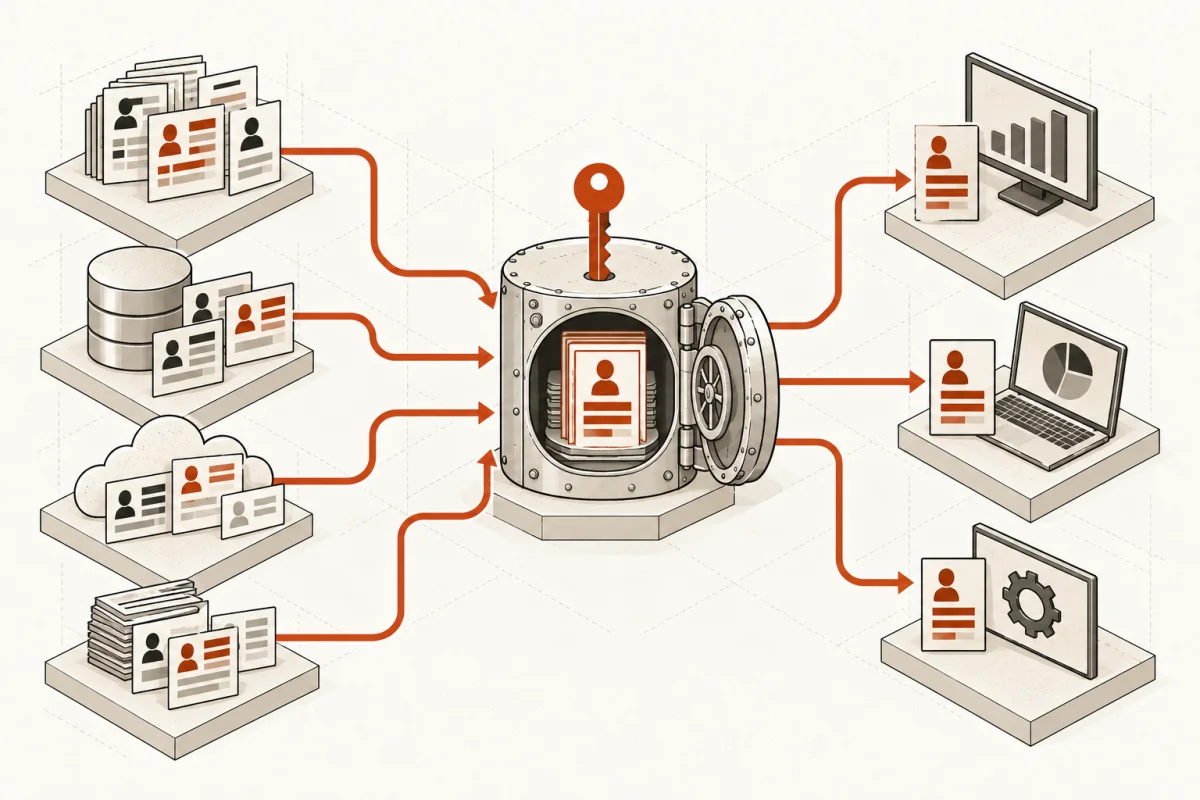
Your team should not need a meeting to answer a basic question: Which customer record is right? A single source of truth business data system gives every department the same dependable answer, without forcing staff to hunt across spreadsheets, inboxes, CRM notes, accounting software, and text messages.
That is not a dashboard project. It is an operating-system project. Done well, it reduces rework, prevents bad handoffs, speeds up decisions, and gives AI systems facts they can use without making up the gaps. Done poorly, it creates one more database nobody trusts.
The actual cost of disconnected data
Most businesses do not have a data problem because they lack software. They have a data problem because each tool holds a partial version of the business.
Sales may consider a lead qualified once a proposal is sent. Operations may not see that customer until a contract is signed. Accounting may create its own record when the first invoice goes out. Customer service may work from email history. By the time a leader asks for pipeline, capacity, receivables, or customer status, four systems can produce four different answers.
The direct cost is easy to recognize: staff copy information between systems, clean up duplicate records, chase approvals, and correct mistakes after a customer notices them. The larger cost is decision drag. Managers stop acting on reports because they do not trust the numbers. Frontline employees create private spreadsheets because the official system is incomplete. Growth exposes the cracks faster than the team can patch them.
AI makes this issue more urgent. An AI agent connected to inconsistent records does not fix inconsistency. It can distribute the wrong answer faster. Before automating follow-up, reporting, intake, scheduling, or document preparation, establish what record is authoritative and when it changes.
A single source of truth does not mean one piece of software
This is where many implementation projects go off course. A single source of truth is not necessarily one platform that stores every file, transaction, conversation, and operational detail. For a small or mid-size business, trying to force everything into one application often creates a costly migration and weaker processes.
Instead, define a source of truth for each critical business object. Your CRM might own lead and customer contact data. Your accounting platform might own invoices, payments, and account balances. Your project system might own delivery status and assigned work. Your document system might own signed agreements and controlled templates.
The system becomes a single source of truth when these records are connected, fields have clear owners, and staff can retrieve a current business view without manually reconciling five tools.
The distinction matters. A roofing contractor may need its field-service platform to remain the authority for job status, while QuickBooks remains authoritative for payment history. A law firm may keep the practice-management system as the matter record and a document repository as the source for final executed files. There is no prize for replacing a tool that already does its job.
Start with the three workflows that cost the most
Do not begin by mapping every possible field across the company. That produces a long requirements document and little operational value. Begin where bad data is already costing money.
Look for workflows with repeated copying, delayed handoffs, missed follow-ups, duplicate entry, or regular arguments about whose numbers are correct. In many businesses, the first three are lead-to-client intake, quote-to-cash, and service or project delivery. In others, the highest-cost work may be scheduling, claims intake, inventory replenishment, compliance documentation, or renewal management.
For each workflow, document four things:
- The trigger that starts the work
- The person or system that owns each decision
- The fields required for the next step to happen correctly
- The system that is authoritative for each field
This is not academic process mapping. It exposes the exact places where staff are doing unpaid integration work with copy-and-paste, memory, and side conversations.
A useful test is simple: when a customer changes an address, scope, appointment, or payment method, where should that change be made first? If the answer is "it depends who notices it," you do not yet have a dependable system of record.
Define data ownership before building automations
Every important field needs an owner. Not a department that is generally responsible, but a named system and a rule for updates.
For example, the sales team may create a customer record in the CRM. When the deal closes, an automation can create the accounting customer and project record. If finance changes a billing contact, that update may flow back to the CRM. If operations changes project status, that may update a customer-facing portal but should not overwrite sales-stage history.
Those rules prevent the most common failure in integrations: two systems overwriting each other with stale information.
You also need a plan for exceptions. A customer may have multiple locations. A business may have a parent entity and several billing entities. A job may be canceled after materials are ordered. Good systems do not pretend these cases will never happen. They route exceptions to a person with authority to resolve them and preserve an audit trail of what changed.
Human ownership is not a limitation. It is the control that makes automation usable. Let systems move routine information. Keep people accountable for pricing exceptions, client commitments, compliance decisions, write-offs, and other judgment calls.
Build a usable business record, not a prettier report
A unified record should answer the questions your people ask while doing their jobs. For a client-facing business, that may include contact details, current opportunity or account status, open work, recent communications, contract status, invoices due, next action, and the internal owner.
That view can live in a CRM, an operations portal, a data layer, or a purpose-built internal workspace. The location matters less than the behavior: it must show current information, make the source visible, and let staff move to the underlying record when detail is needed.
Avoid the temptation to treat a dashboard as the solution. Dashboards summarize data. They do not govern it. If an executive report says revenue is down while the source records are duplicated, delayed, or misclassified, the chart merely makes the confusion look official.
A better sequence is to clean the records that drive the workflow, establish update rules, connect systems, and then report from the controlled data. The report becomes useful because the operation behind it is reliable.
Security and access rules are part of the design
A single source of truth should not mean every employee can see every piece of information. A healthcare provider, financial advisor, law practice, and contractor all have different confidentiality requirements, but every business needs access boundaries.
Set permissions around job function. A scheduler may need service addresses and appointment windows but not payroll data. A sales representative may need lead history but not detailed margin information. An AI assistant should receive only the fields needed to perform its assigned task.
For sensitive data, keep identifiers and documents inside approved systems whenever possible. Log automated changes. Require human approval for actions that create financial, legal, employment, or client-facing commitments. These controls may add a step to certain workflows. That trade-off is usually worth it because an automation that cannot be explained or overridden is not business infrastructure. It is a liability.
Measure adoption, not just integration completion
A technical team can declare an integration complete while employees continue working from spreadsheets. That is not success.
Track whether the new record is being used in the weekly work that matters. Measure duplicate-record rates, time from lead to first response, time spent preparing status updates, overdue follow-ups, exception volume, and the percentage of staff using the system each week. If the baseline was 10 hours of manual preparation per week and the new process saves eight, that is a visible result. If no one uses the workspace after launch, investigate the workflow rather than celebrating the build.
At Main & Machine, this is why implementation begins with a scoped operating problem, not an AI demo. The goal is a working system that earns its place in the day-to-day operation.
Build in stages and keep the first release narrow
Most businesses can make meaningful progress in 90 days without attempting a full data transformation. The first release should connect the most expensive workflow, establish authoritative records, handle common exceptions, and give the team a clear operating view.
Then expand. Add the next workflow once the first one is stable. Improve field quality based on real usage. Introduce AI agents after the underlying data and approval rules are clear. A staged approach limits disruption and makes return on investment easier to measure.
The right question is not, "How do we put all our data in one place?" Ask, "What must be true for our people to make the next good decision without hunting for facts?" Build that answer first, make ownership explicit, and let the system prove its value in the work your team already does.
Where this shows upWhat we actually build →