AI Lead Response Automation That Holds Up
AI lead response automation cuts delays without handing customer decisions to a bot. Learn what to automate, what people should own, and how to measure it.
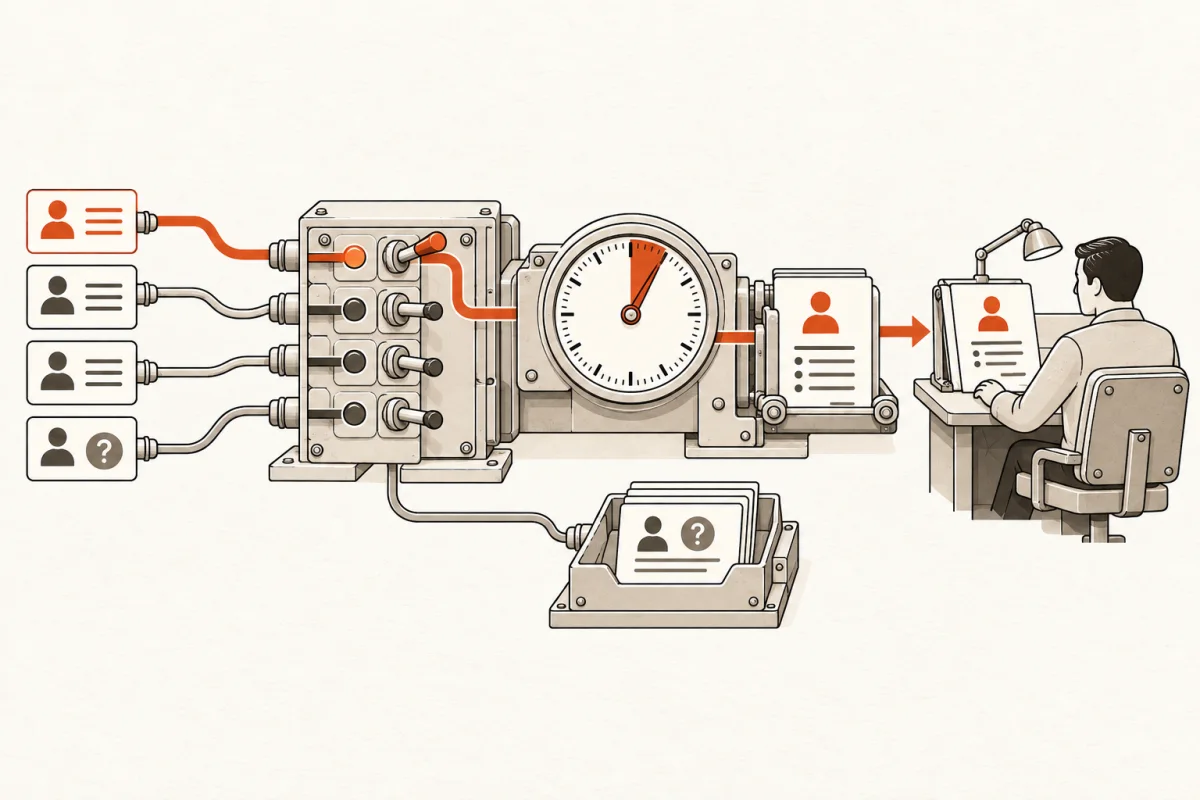
A prospect submits a form at 8:12 p.m. Your team sees it at 8:30 the next morning, after checking email, voicemail, a CRM queue, and a shared inbox. By then, the prospect has likely contacted two competitors. That is the actual problem AI lead response automation should solve: not replacing salespeople, but removing the dead time between buyer intent and an accountable human response.
For a small or mid-size business, lead response is rarely one broken task. It is a chain of small failures: incomplete forms, leads routed to the wrong person, delayed callbacks, duplicate records, missing notes, and no follow-up when the first message gets ignored. Adding an AI chatbot on top of that mess does not fix the operation. It can make it harder to see who owns the next step.
What AI lead response automation should do
A working system receives a lead from the places your buyers actually use - website forms, phone calls, web chat, email, scheduling tools, paid-ad platforms, referral forms, or social inboxes - and creates one usable record. It identifies the source, captures the available context, checks for an existing contact, and routes the opportunity according to rules your business can explain.
AI adds value when the incoming information is unstructured. A prospect may write a long email describing a construction project, leave a voicemail about an insurance renewal, or send a chat message that mixes questions, budget concerns, and an urgent request. An AI layer can summarize the request, extract key facts, classify the inquiry, flag urgency, and prepare a response draft for the appropriate employee.
The system can also send an immediate acknowledgment that sets a real expectation. “We received your request and a project manager will review it by 10 a.m. tomorrow” is useful. “Our AI assistant is thrilled to help” is not. The first message should confirm receipt, collect only the missing information needed to move forward, and avoid promises your team cannot keep.
That distinction matters. Speed improves conversion only if the response is relevant, accurate, and followed by a person who can act.
Automate the handoff, not the judgment
The strongest lead-response systems make ownership visible. They do not let a lead disappear into an automated sequence because the routing logic was vague or because a sales rep assumed someone else would handle it.
Start by defining the non-negotiable states of a lead. It has been received. It has been assigned. The owner has acknowledged it. It has been contacted. It is qualified, disqualified, scheduled, or still awaiting a response. Each state needs a timestamp and an accountable person.
AI can support each stage without becoming the decision-maker. It can classify an inquiry as a likely commercial account versus a consumer request, suggest the best rep based on territory or expertise, and draft a tailored reply using approved company information. It should not independently approve discounts, give legal or medical advice, confirm availability it cannot verify, or decide that a high-value prospect is unqualified based on a weak signal.
This is especially important in regulated and trust-heavy businesses. A law practice may automate intake summaries and conflict-check preparation, but an attorney owns whether representation is appropriate. A healthcare provider may route appointment requests and collect administrative details, but staff own clinical guidance. An insurance agency can prepare a coverage inquiry for review, but a licensed professional owns the recommendation.
The rule is simple: automate preparation, routing, reminders, and recordkeeping. Keep consequential judgment with the person paid and authorized to make it.
Build around response-time commitments
Many companies measure lead volume and close rate but never measure the time between inquiry and meaningful contact. That leaves a major revenue leak hidden inside the process.
Set response standards by lead type. A missed call from an existing client may require a return call within 15 minutes. A website estimate request might require acknowledgment within two minutes and personal outreach within one business hour. A low-fit inquiry can receive a helpful automated response and a later review. The targets depend on your staffing, sales cycle, and customer expectations. What matters is publishing the rules internally and making performance measurable.
Then build escalation into the workflow. If the assigned owner does not acknowledge a high-intent lead within the allotted window, the system alerts a manager or reassigns it. If a prospect replies after hours, the system captures the reply and queues the next action for the on-call person or next business day. If a contact has not received a response after a set period, the system creates a visible exception rather than quietly sending another generic email.
This is where automation earns its keep. It does not merely send messages. It prevents missed commitments.
Use the data you already have, carefully
AI lead response automation is only as useful as the information it can safely access. A response system needs the right business context: services, service areas, pricing boundaries, available appointment types, sales territories, ownership rules, customer status, and approved answers to common questions.
It does not need unrestricted access to every file in your company. Giving a general-purpose model broad access to contracts, payroll folders, financial records, or protected client information is not a serious implementation plan.
Define the minimum data required for each workflow. For example, a home-services inquiry agent may need service categories, zip-code coverage, operating hours, and job-type exclusions. A B2B consulting inquiry workflow may need industry focus, minimum engagement size, calendar availability, and the correct account executive. Keep sensitive data segmented, log system activity, and decide what information may leave your environment before connecting outside AI services.
There is a trade-off. Tighter data controls can mean less personalized automated communication at first. That is usually acceptable. A response that is fast, accurate, and appropriately limited beats a highly customized message built on data your business should not have exposed.
Design the first response for the next action
The goal of the first message is not to imitate a sales conversation. Its job is to move the lead into a useful next step.
For straightforward requests, that may be a scheduling link with the correct appointment type. For a more complex inquiry, it may be two focused questions that allow a human to prepare. For an urgent service issue, it may be confirmation that the request has been sent to dispatch, with clear instructions for emergencies.
Avoid long AI-generated emails that restate the prospect's problem and bury the call to action. They sound polished but often create more reading than progress. Keep acknowledgment messages short. Use the prospect's stated need. State what happens next and when. Ask only for information that changes routing, scope, or readiness.
The same principle applies to follow-up. If a prospect does not reply, do not send three variations of “just checking in.” Use a sequence that gives a reason to respond: a reminder of the requested service, a direct scheduling option, a request to confirm timing, or a clear close-the-loop message. Stop when the lead opts out, becomes a customer, or has been marked as unsuitable by a person.
Measure operational results, not chatbot activity
A dashboard full of message counts can hide a poor process. Track the numbers that show whether the system improves revenue handling and staff workload.
At minimum, measure median time to acknowledgment, median time to human contact, percentage of leads assigned within target, percentage contacted within target, appointments set, qualified opportunities created, and leads with no documented next step. Compare these by source. A paid-search lead, referral, missed call, and trade-show inquiry may need different workflows and produce very different outcomes.
Also review the failure queue every week. Look at leads the system could not classify, messages it drafted poorly, records it could not match, and cases that triggered escalation. These are not edge cases to ignore. They are the operating evidence that tells you where rules, data, or staffing need adjustment.
A practical implementation should produce a baseline before changes go live. If the current average callback time is 11 hours and the new process brings it down to 45 minutes, that is a useful result. If staff save six hours a week on manual data entry but qualified appointments do not increase, investigate before claiming victory. Faster activity is not automatically better sales performance.
Start with one controlled workflow
Do not begin by asking for an AI system that handles every lead from every channel. Start with the lead type that is expensive to miss and simple enough to define. That might be website consultation requests, after-hours missed calls, quote forms, or incoming service emails.
Map the current process from inquiry to first human conversation. Identify the systems involved, the required data, the approval points, the routing rules, and the failure conditions. Build the workflow with a human review path and a clear way to override it. Run it against real but controlled traffic, inspect the results, then expand.
Main & Machine approaches these projects as operational infrastructure, not a chatbot purchase. The work is in connecting the tools, defining ownership, protecting data, training staff, and keeping the system understandable after launch.
Your fastest response is only valuable if it leads somewhere. Build AI lead response automation so every inquiry receives a timely, useful next step and every important decision still has a name beside it.
Where this shows upWhat we actually build →