AI Consulting for Small Business That Ships
AI consulting for small business should fix costly workflows, not create slides. Learn what to buy, what it costs, and how to keep control of decisions.
A dispatcher copies job details from email into scheduling software. An office manager rekeys the same customer information into three systems. A sales lead waits until tomorrow for a reply because the team is busy serving current customers. None of this is a strategy problem. It is an operations problem with a measurable labor cost.
AI consulting for small business is worthwhile when it turns those repeatable bottlenecks into working systems your team can inspect, override, and use every week. It is not worthwhile when it ends with a slide deck, a generic training session, or an impressive demo disconnected from the tools and data your business already relies on.
Start with the cost, not the AI
Most owners do not need an AI roadmap covering every department. They need a clear answer to a narrower question: where is the business paying people to move information, chase routine decisions, or repair avoidable mistakes?
Begin by identifying the three workflows with the highest combined cost in staff time, delay, rework, and missed revenue. That could be lead intake, quote preparation, document collection, client onboarding, appointment follow-up, invoice coding, job scheduling, or internal reporting.
A useful assessment follows the work from start to finish. Who starts it? What systems are touched? Where does someone copy and paste information? What exceptions require judgment? What happens when information is missing or wrong? How long does the work take, and how often does it occur?
This matters because not every manual process should be automated. A workflow that happens twice a month may not justify a custom build. A process that occurs 30 times a day, consumes 15 minutes each time, and creates downstream errors probably does. Volume, consistency, and business impact determine the case.
What good AI consulting for small business actually delivers
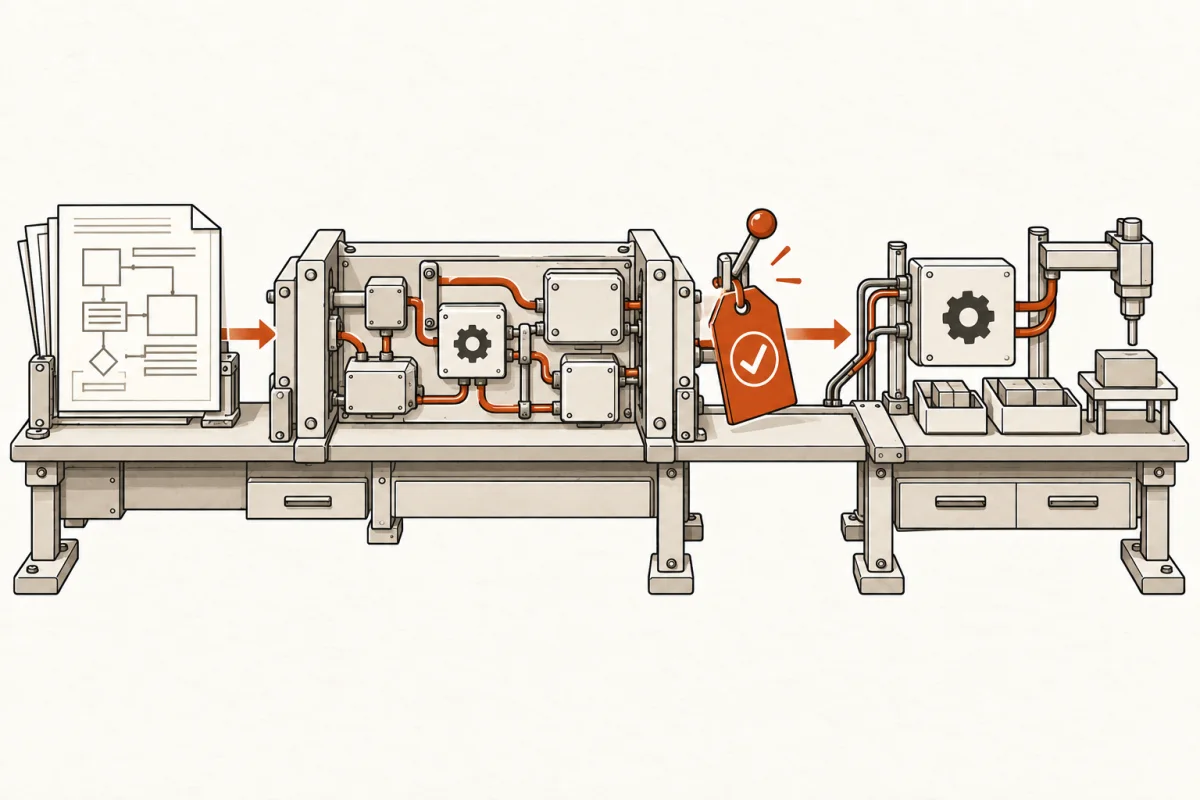
The deliverable should be operational infrastructure, not advice alone. A capable implementation partner maps the workflow, connects the necessary systems, builds the automation or agent, tests it with real business cases, trains the people who will run it, and defines what happens when the system is uncertain.
For a professional-services firm, that may mean an intake system that reads a new inquiry, creates a structured matter record, requests missing documents, drafts a first response, and routes unusual cases to the right person. For a contractor, it may mean turning field notes, photos, and customer messages into a job summary that feeds estimating and scheduling. For an e-commerce operator, it may mean classifying support requests and preparing responses using current order data without letting AI issue refunds on its own.
The technology varies. The operating principle does not: automate repetitive preparation and information movement, then keep accountable people responsible for commitments, approvals, and exceptions.
That distinction protects both quality and trust. AI can prepare a recommendation, summarize a file, flag a missing detail, or draft customer communication. It should not quietly make a legal determination, approve a payment, alter a medical record, or promise a delivery date without an authorized person in the loop.
Demand a defined scope before you buy
Vague scope is where AI projects become expensive experiments. Before an engagement begins, you should be able to see the workflow being addressed, the systems involved, the user groups, the expected handoffs, and the specific outcome that will count as production deployment.
Ask direct questions. Which data will the system access? Where will that data be stored and processed? What information will leave our existing environment? Which actions can the system take automatically, and which require approval? How will failures be logged? Who owns the build, the prompts, the documentation, and the configuration after launch?
A serious consultant will answer in plain language and identify constraints early. Legacy software may have no usable integration. Customer data may require tighter handling than a public AI service permits. A workflow may contain enough exceptions that partial automation is the smarter first move. Those are not reasons to stop. They are reasons to scope honestly.
Fixed written pricing is equally important. A project can have a published range and still require discovery, but you should not be asked to approve an open-ended technical adventure. The right sequence is a paid readiness audit or scoped assessment, a written implementation plan with a fixed price, then managed support if the system needs monitoring and improvement.
Buy a system your staff can override
The fastest way to lose staff adoption is to install a black box that changes work without explaining itself. Employees know where the process breaks. If the new system cannot show what it used, why it made a recommendation, or how to correct it, people will work around it.
Build for human review at the points where judgment matters. A sales coordinator should be able to edit a drafted reply before it is sent. An accountant should approve a categorization exception. A practice manager should see the source details behind a generated summary. Supervisors should have a simple way to pause automation when policies, staffing, or customer needs change.
This is not a concession to old habits. It is a control system. Explainable, overridable AI is easier to govern, easier to improve, and less likely to create quiet errors at scale.
Training should be part of implementation, not an afterthought. The people doing the work need to understand the new handoffs, what they remain accountable for, and how to report a bad output. Managers need usage and exception reporting so they can tell whether the system is saving time or merely moving work around.
Measure value in hours, speed, and error reduction
“Better efficiency” is too vague to manage. Establish a baseline before the build, then measure the same operational facts after launch: preparation time per case, lead-response time, backlog volume, error rates, cycle time, rework, and weekly active use.
A simple return model is usually enough. If five employees each recover four hours per week from repetitive preparation, that is 20 hours returned every week. Multiply that by a realistic loaded hourly cost, then compare it with the implementation and ongoing support cost. Add revenue effects carefully. Faster lead response or more consistent follow-up may create upside, but do not present it as guaranteed until the data proves it.
Usage matters as much as projected savings. A system that looks good in a demo but is used by 15% of the team has not solved the operating problem. Main & Machine measures production use because adoption is evidence that the build fits the real workflow, not just the requirements document.
Choose the first project for proof, not prestige
A company-wide AI overhaul sounds ambitious. It is also difficult to govern, train, and validate. Most small and mid-size businesses get better results by beginning with one high-cost workflow that has a clear owner, enough volume, accessible data, and a visible finish line.
That first deployment should be live quickly, ideally within roughly 90 days when the integrations and data conditions support it. The goal is not to automate every corner of the business. The goal is to establish a working pattern: map the process, connect the data, put controls around decisions, train the team, measure the result, and improve from actual use.
After that proof, expansion becomes less speculative. You know which systems can be connected, where data needs cleanup, which teams adopt the tools, and what level of managed support makes sense. Some businesses need a few targeted automations. Others need a unified back-office system spanning multiple departments. The correct answer depends on the cost of the work and the complexity of the operation, not on how fashionable AI sounds.
The practical test is simple: if a proposed AI project cannot name the workflow, the owner, the controls, the deployment date, and the measure of success, do not buy it yet. Get those answers first. Then build the part of the business that is costing you time every day.
Where this shows upWhat we actually build →