Why Everything Happened at Once
Three slow curves crossed in the same decade, and the crossing explains both the breakthrough and the noise.
In November 2022, a research lab released a chat interface to a language model, mostly as a demonstration. Within two months, by widely cited estimates, a hundred million people were using it, the fastest adoption of a consumer application the world had seen to that point.
To anyone watching from inside a normal business, it felt like the technology fell out of the sky. One quarter, AI was a research curiosity and a punchline about chatbots. The next, your nephew was using it to write cover letters and your competitors were issuing press releases.
Sudden arrivals deserve suspicion, so it is worth asking the real question: why now? The capability was decades in the making, as the first essay in this series argued. What made it surface in this particular decade? The answer is that three long, slow, independent curves happened to cross at the same time, and the crossing point is where we live.
The First Curve: An Architecture That Could Scale
For years, the systems that processed language read text the way you do, one word after another, which made them slow to train and forgetful over long passages. In 2017, researchers at Google published a paper with the swaggering title “Attention Is All You Need,” introducing a design called the transformer. The technical details matter less than the consequence: a transformer can weigh every word in a passage against every other word simultaneously, which means training can be spread across thousands of chips working in parallel.
That sounds like an engineering footnote. It was the hinge of the whole era. Before the transformer, throwing more computers at a language model hit diminishing returns quickly. After it, researchers discovered something almost embarrassing in its simplicity, formalized in what are now called scaling laws: make the model bigger, feed it more text, give it more computing power, and it gets better, smoothly and predictably, like a dial you can simply keep turning. Much of the last decade in AI is the story of well-capitalized labs turning that dial as hard as the supply chain allowed.
The Second and Third Curves: The Fuel and the Furnace
A dial is only useful if you can afford to turn it, and here the second curve enters from an unlikely direction: video games. The graphics processing unit, the GPU, was built to render explosions for teenagers, a job that consists of doing millions of small calculations at once. That happens to be the exact shape of the math inside a neural network. Decades of gamers funded the development of chips that turned out to be the furnace AI needed, and the company that made the best ones, Nvidia, found itself transformed from a gaming brand into one of the most valuable enterprises on earth.
The third curve was the fuel. Training a model of this kind requires a meaningful fraction of everything humanity has ever written, and until recently no such corpus existed in usable form. Then thirty years of the internet happened. Billions of people, without ever intending to, typed out the largest record of human language, knowledge, argument, and style ever assembled, and left it lying around in machine-readable form.
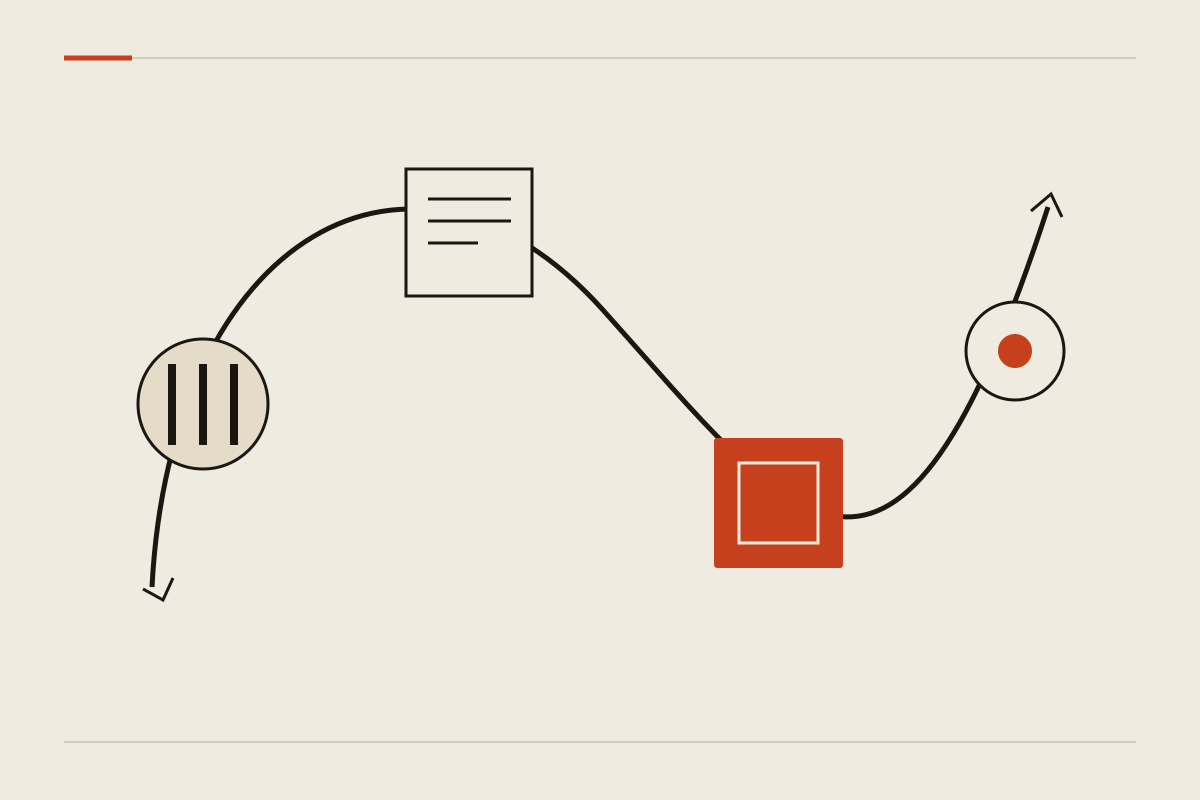
An architecture that scales. Chips that can run it. A corpus that can feed it. Any one of these alone produces a research paper. All three together produced the moment you are living through.
The Pattern Has a History
Convergence stories are how general-purpose technologies always arrive. The automobile needed cheap steel, refined gasoline, and machine tools to mature in the same generation; the pieces existed separately for years before they snapped together. Commercial aviation waited on aluminum, engines, and instruments. The technology that changes everything is usually an assembly of technologies that each changed little on their own.
The history matters because it answers the question every owner eventually asks me, usually with one eyebrow raised: is this a bubble? Here is the truth: the financial mania and the real technology are separate questions, and history says yes to both. The British railway mania of the 1840s incinerated investor fortunes on a spectacular scale, and Britain kept the railways, which went on to reorganize the economy for a century. The dot-com crash of 2000 wiped out trillions in paper value, and the internet did not get any less important on the way down. Capital overshoots. Capability compounds. When some of today’s AI valuations deflate, and some will, the data centers, the chips, the trained models, and the working deployments inside businesses will all still be there the next morning.
So separate the two curves in your own mind, because they ask different things of you. The hype curve, the one made of funding rounds and keynote demos, is entertainment; you can ignore it without cost. The capability curve, the one made of falling prices and accumulating competence, is the one your decisions should track. It moved before the headlines arrived. It will keep moving after they leave.
Three slow curves crossed, and the world noticed all at once. The noticing was sudden. The arriving never was.
Where this shows upWhat we actually build →