The Buildings Behind the Intelligence
The intelligence feels weightless, and the infrastructure behind it is some of the heaviest industry on earth.
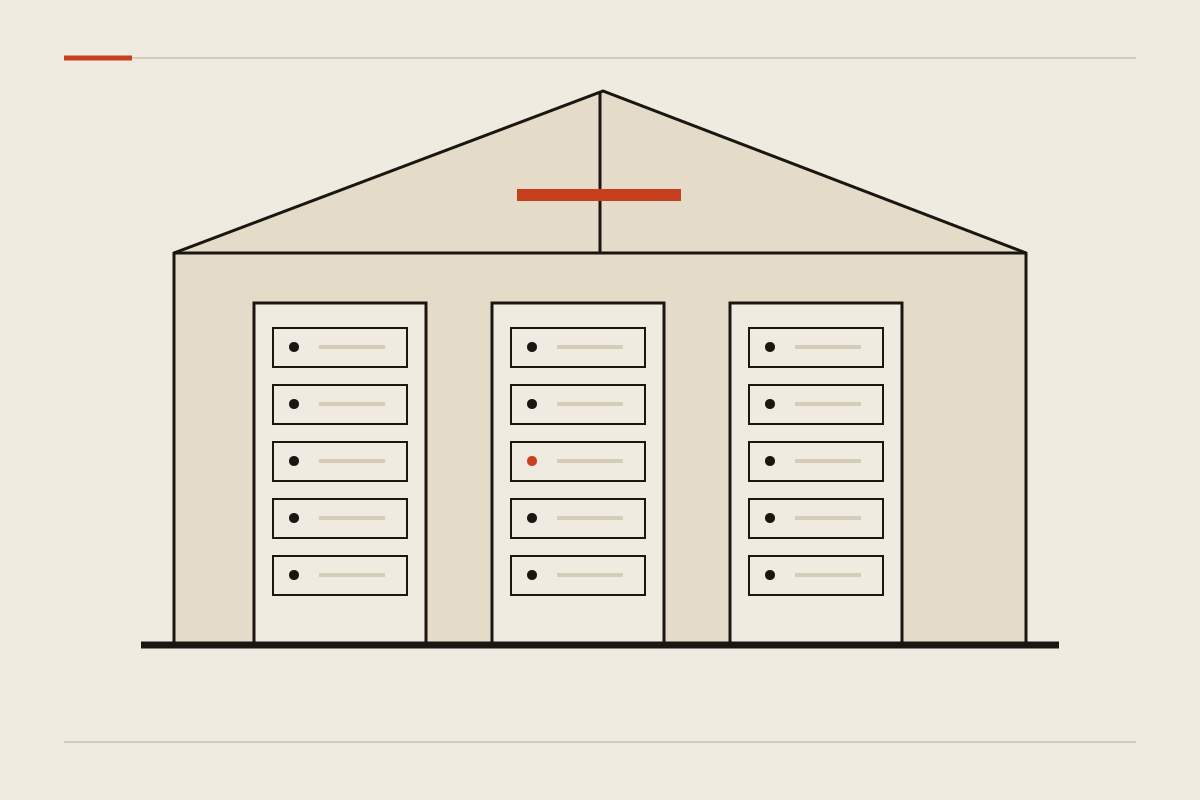
Drive the right roads outside Phoenix and you will pass buildings the size of shopping malls with no windows, no signage worth reading, and substations beside them scaled for a small city. There is a good chance the email your software drafted this morning passed through one of them.
We talk about AI as if it were weather, ambient and immaterial, something “in the cloud.” The cloud has a street address. It hums, it drinks water, and it has become one of the largest construction projects in the history of the country. When the news talks about hundred-billion-dollar infrastructure commitments and utilities revising their forecasts upward for the first time in a generation, this is what they are describing, and an owner is right to ask what any of it has to do with a fifteen-person firm.
More than you would think. The buildings explain the prices, the politics, and the durability of the whole enterprise.
What Actually Happens Inside
A data center is, reduced to essentials, a warehouse for computation: racks of specialized chips, the GPUs described earlier in this series, running around the clock, with most of the building’s ingenuity devoted to two unglamorous problems, delivering enough electricity and removing the resulting heat.
The computation comes in two distinct flavors, and the distinction is worth keeping. Training is the education: months of thousands of chips working in concert to produce a model, a one-time industrial act with a price tag now reaching into the hundreds of millions of dollars for frontier systems. Inference is everything after graduation: the millisecond-scale work of answering queries, drafting paragraphs, and running the automations inside businesses like yours. Training built the graduate. Inference is the graduate doing its job, billions of times a day, and as AI seeps into ordinary software, inference is becoming the larger share of the load.
All of it runs on electricity, at a scale that has made power the binding constraint of the industry. Data centers already consume a low single-digit percentage of the world’s electricity, and every serious forecast points up. The chips themselves flow overwhelmingly from a handful of facilities, most prominently in Taiwan, which is why chip supply shows up in diplomatic communiqués and why “compute” is now discussed in capitals the way oil has been for a century. The intelligence may be artificial. The kilowatt-hours, the water, the concrete, and the geopolitics are entirely real.
The Dynamo’s Lesson
When economic historians want to explain moments like this one, they reach for electrification, and the comparison is instructive in a specific way. The power stations came first, enormous capital outlays made on faith, and for decades the productivity statistics barely moved. The economist Paul David famously showed why: factories had been built vertically around a central steam shaft, and simply bolting an electric motor onto the old layout captured almost nothing. The gains arrived only when a generation of owners redesigned the factory floor itself, flat, flexible, with power delivered wherever the work was. The infrastructure was necessary. The reorganization was the payoff.
We are in the power-station phase. The capital is being poured now, ahead of the reorganization, which is exactly the order these things always run in. And just as the grid eventually made it absurd for a factory to generate its own power, the data center buildout means intelligence is being industrialized into a metered utility you rent by the token, at prices that have fallen steadily as the buildings multiply and the chips improve.
Now, the skeptical reading, because it deserves a hearing: if the money is being spent this far ahead of the proven returns, some of it is being spent badly. Almost certainly true. Overbuilding is the signature of every infrastructure boom, railways included, and some of today’s announced projects will be quietly shelved. But notice what overbuilding did to the price of rail freight, long-distance calls, and bandwidth: it crushed them, to the lasting benefit of every business that used them. If the boom overshoots, the most likely casualty is investor returns, and the most likely beneficiary is you, renting ever-cheaper intelligence from people who paid for the buildings.
What the Owner Takes From This
Three things, none of which require you to think about cooling systems again.
First, permanence. Whatever happens to individual vendors or valuations, the physical base of this technology, the buildings, chips, and power contracts, now rivals the infrastructure of any industry on earth. The capability is load-bearing. Plan as if it is staying, because it is.
Second, price direction. The cost of a unit of machine intelligence has fallen relentlessly and the competitive buildout is designed to keep it falling. Automations that pencil out marginally today will pencil out comfortably in two years. If a workflow is worth doing, the economics are moving in your favor, and toward the smallest buyers fastest.
Third, groundedness. The next time a vendor or a keynote speaks of AI as something mystical, remember the windowless building outside Phoenix and its substation. This is industry: chips, power, cooling, freight. Industry can be evaluated, priced, negotiated with, and held to account. Mystique cannot, which is precisely why some people prefer to sell it that way.
The machine is the tireless part, and it turns out tirelessness is heavy. Somebody had to pour the concrete. Your job is merely to decide what the building does for yours.
Where this shows upWhat this infrastructure costs you monthly →