Open Models, Closed Models
The choice between renting intelligence and owning it is older than the technology, and the tradeoffs are the usual ones.
Sooner or later, every owner who gets serious about this technology asks me a version of the same question, usually leaning back in the chair as they ask it. Should we be running our own?
They have read that some models are "open" and can be downloaded, owned, and run on hardware you control, while the famous ones are "closed," rented through the cloud from a handful of large labs. The framing arrives pre-loaded with feelings: ownership sounds prudent, renting sounds dependent, and nobody who built a business from scratch enjoys dependence. The feelings deserve respect. The decision deserves arithmetic.
What the Words Actually Mean
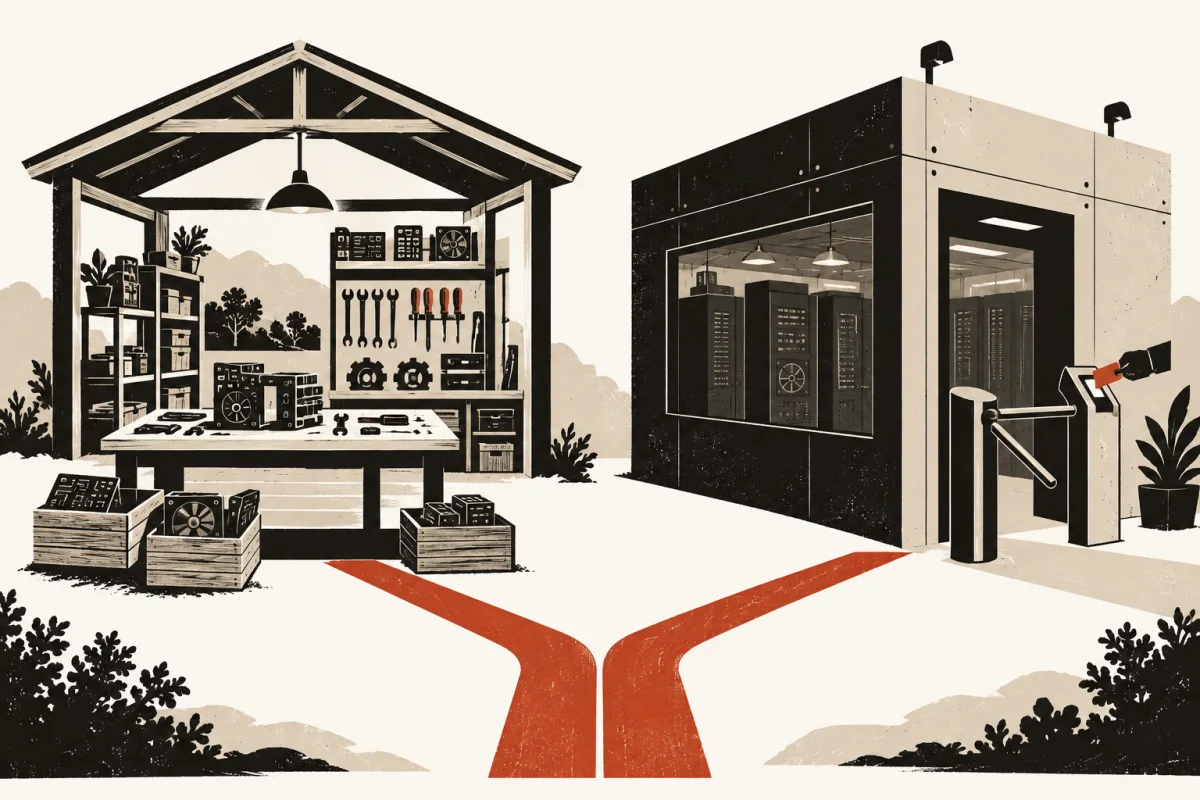
A closed model is a service. The lab that trained it, an OpenAI, an Anthropic, a Google, hosts it in the data centers described earlier in this series, and you reach it through the internet, paying by the token or by the seat. You never possess the model; you possess access. In exchange, you get the frontier of capability, someone else's operations team, and improvements that simply appear.
An open-weight model is a possession. Labs such as Meta and a number of international players release the trained model itself, the billions of tuned dials, for anyone to download. Run it on your own servers or your own rented cloud, and your data never leaves premises you control, no usage meter runs, and no vendor can deprecate, reprice, or alter what you depend on. In exchange, you have just acquired an operations burden: hardware or cloud contracts, updates, security, and the specialized staff who keep it all breathing. The best open models now trail the closed frontier by a margin measured in months rather than years, a gap that keeps narrowing, but for the hardest work, the frontier remains rented.
If the shape of this tradeoff feels familiar, it should. It is own-versus-lease, the oldest decision in business, wearing new vocabulary.
The Generator in the Basement
History offers a precise rhyme. In the early decades of electrification, serious factories generated their own power; the grid was young, unreliable, and nobody wanted the heartbeat of the plant in a stranger's hands. Then the utilities scaled, prices collapsed, reliability inverted, and one by one the private generators went quiet, kept, if at all, as backup. Owning your power went from prudence to eccentricity in a generation, except for the steel mills and aluminum smelters whose consumption was so enormous, or whose requirements were so particular, that ownership still penciled.
The intelligence market is industrializing along the same curve, and the same exceptions apply. Renting from the grid is the right answer for most, and ownership remains the right answer for a principled few. The craft is knowing which one you are.
The Honest Decision Rule
Three questions sort nearly every case I have seen.
First, what does your data require? For most firms, the business-grade tiers of the closed providers, with written commitments not to train on your inputs, clear the bar comfortably; the next essay in this series treats this in full. But some businesses answer to regulators, contracts, or clients for whom "it never leaves our infrastructure" is the requirement, full stop. Clinics under privacy law, firms with defense work, shops whose crown-jewel data is the business: for them, open models running in-house are the entire reason the category exists.
Second, what is your volume? At typical small-business consumption, rented tokens cost lunch money and ownership costs a salary. The arithmetic flips only at industrial scale, when an automation runs millions of times a month and the meter starts to rival the payroll it replaced. Almost nobody under a hundred employees is there. The ones who are, know it from their invoices.
Third, who maintains it? An open model in production is a system: monitored, patched, upgraded, secured. If the honest answer to "who owns that" is the same overstretched person who owns everything else technical, the hidden cost of ownership has already exceeded the visible cost of rent.
Now, the objection that deserves the most respect: dependence is a real risk, and the vendors know it. Prices can rise; models can be retired; terms can shift. Here is the working answer from the field. The defense against vendor risk is rarely ownership; it is portability. Build your automations so the model is a replaceable part, your prompts, your retrieval library, your workflows kept cleanly separate from any one provider, and the threat of switching does the negotiating for you. The intelligence market currently has something electricity never did: a half-dozen fierce competitors and a public commodity alternative improving by the quarter. That competition is your leverage, and it works best when you stay light enough to use it.
So: rent the frontier, keep your bags packed, and let the few businesses with true sovereignty requirements carry the burden of the basement generator. Ownership of the model was never the prize. Ownership of the workflow, the data, and the decision was, and that kind you cannot rent in either direction.
Where this shows upWhere your AI data actually goes →