How to Talk to the Machine
The quality of the output is mostly a property of the request, and writing a good request is a learnable skill.
Two employees at the same firm, same week, same tool. One declared it useless and went back to doing everything by hand. The other quietly cut a four-hour Friday task to forty minutes.
I have watched this exact split inside more businesses than I can count, and the variable is almost never the software, the seniority, or any native gift for technology. The variable is the request. One typed “write a proposal for the Henderson job.” The other typed three paragraphs: what the job was, who would read the proposal, what mattered to that reader, what the price needed to convey, and a previous proposal that had won. Same machine, different briefing, opposite outcomes.
The industry calls this skill prompting, which makes it sound like a specialty. It is closer to something every owner already knows how to do, and the fastest way to learn it is to notice what it resembles.
Delegation, Rediscovered
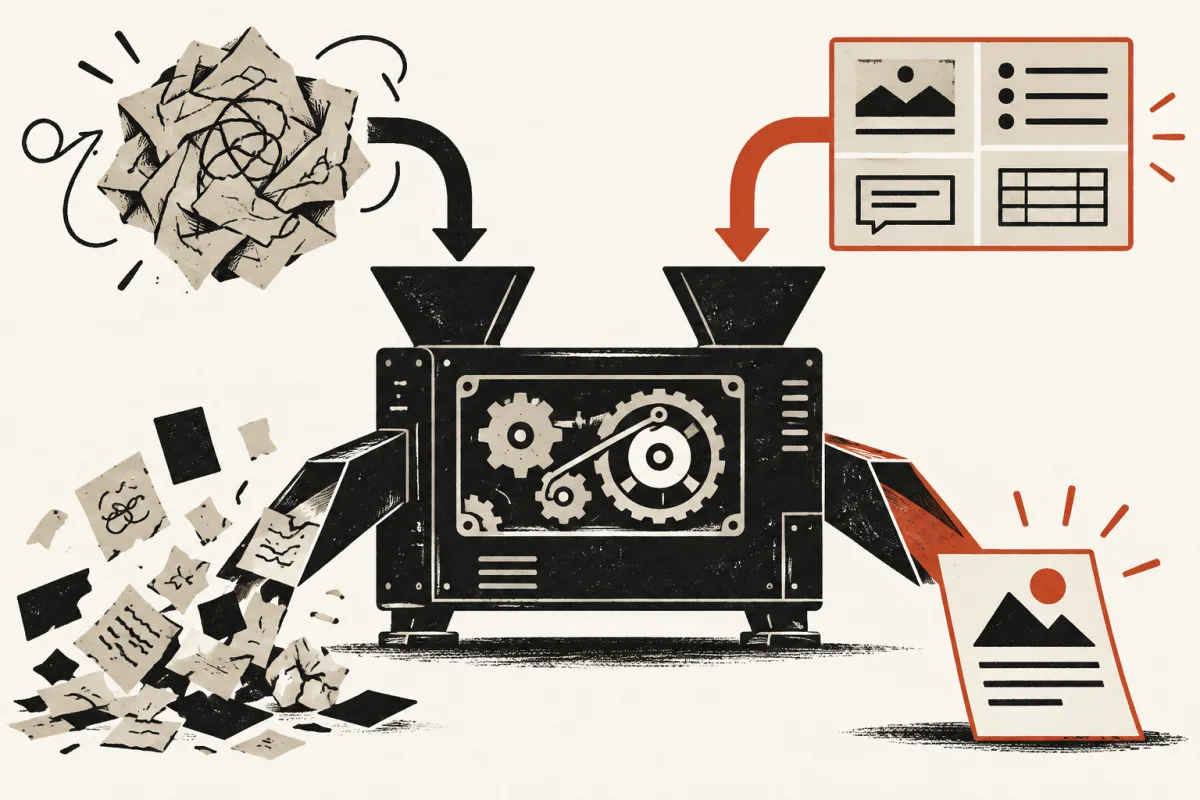
Recall the mechanics from earlier in this series: the model produces the most plausible continuation of whatever you give it. Hand it a vague request and it must guess at everything you left out, the audience, the tone, the format, the facts of your situation, and it guesses generic, because generic is the safest continuation of vague. The emptiness of the answer is a mirror of the emptiness of the question.
Which means the master skill here was never technical. It is briefing, the same skill you use on a capable new hire’s first morning. You would never tell a new estimator “write a proposal for the Henderson job” and walk away. You would explain the client, point to a good example, flag the mistake that always costs, and stay available for questions. The people who get remarkable output from these machines are simply the people who delegate well, and the people who get mush are hearing, for the first time in writing, what their delegation has always sounded like. More than one owner has told me the technology made them a better manager of humans, because the machine, unlike a polite employee, returns your vagueness to you verbatim.
There is one difference from a human hire worth respecting: the machine knows nothing about you that you do not include. It has no memory of your last meeting, no feel for your standards, no context beyond the window described earlier in this series. The briefing must carry everything. That sounds like a burden until you realize it can be written once and reused forever.
The Six Habits
Here is the working method, compressed from hundreds of deployments into the version I teach.
State the job, the reader, and the format in the first lines. “Draft a follow-up email to a commercial client who has gone quiet on a signed estimate, friendly but firm, under 150 words” outperforms a paragraph of throat-clearing.
Provide the raw material. The relevant facts, the prior correspondence, the three pages that matter. The model grounded in your documents answers from them; the model without them answers from the average of the internet.
Show one example of done-right. A previous winning proposal, a past email in your voice. Nothing communicates a standard faster, to machines or to people.
On complex work, ask for questions before answers. “Before drafting, ask me anything unclear” surfaces the ambiguities you forgot you were carrying, and the machine asks surprisingly good questions.
Iterate instead of restarting. The second instruction, “shorter, warmer, drop the second paragraph,” is where the tool starts feeling like a collaborator. Most people quit one revision before the good version.
Save what works. A briefing that produces excellent output is an asset. Name it, file it, and hand it to the next employee. A library of proven prompts is the cheapest standard-operating-procedure manual ever written.
Now, the objection I hear from the back of the room: shouldn’t the machine just be smart enough to know what I want? Increasingly, it is; the newer models infer more from less, and the gap between a lazy request and a careful one is narrower than it was two years ago. But the gap will never close, for a reason that has nothing to do with technology. No intelligence, human or otherwise, can read a mind. Clarity about what you actually want is the one input that cannot be automated, and the discipline of producing it pays you twice, once in the output and once in your own thinking.
The Skill Beneath the Skill
A client of ours, a managing partner in her sixties, put it better than any consultant deck I have seen. After a month with the tools, she said the real product was the writing of the requests themselves: being forced, four or five times a day, to articulate exactly what good looks like before any work begins.
That habit predates the technology by several thousand years and will outlive every model on the market. The machine simply made it instantaneous to test. Say precisely what you want, and watch how often you get it. The lesson generalizes.
Where this shows upChatGPT vs. custom AI →