How Much Does AI Implementation Cost for SMBs?
How much does AI implementation cost? See practical price ranges, the scope behind each number, and how to model a defensible business return before you buy
A business owner asking how much does AI implementation cost is usually not shopping for a chatbot. They are trying to stop lost leads, manual reporting, duplicate data entry, slow intake, inconsistent follow-up, or staff spending skilled hours on work that software should handle. The price depends on whether you are buying a useful operating system for a real workflow or a demonstration that never becomes part of the business.
The short answer: a focused AI workflow implementation often costs $15,000 to $50,000. A multi-workflow operational system commonly lands between $50,000 and $150,000. Larger, department-spanning systems with substantial integration, governance, and data work can run $150,000 to $500,000 or more.
Those ranges are broad because “AI implementation” covers very different work. A lead-routing agent connected to your CRM is not the same project as a system that reads documents, coordinates work across departments, prepares management reports, and keeps an auditable record of what happened. Treating them as the same purchase is how budgets get distorted.
What you are actually paying for
The model itself is rarely the expensive part. Most modern AI models are available through usage-based software services, often at costs measured in cents or dollars per task. The implementation cost comes from making that capability dependable inside your operation.
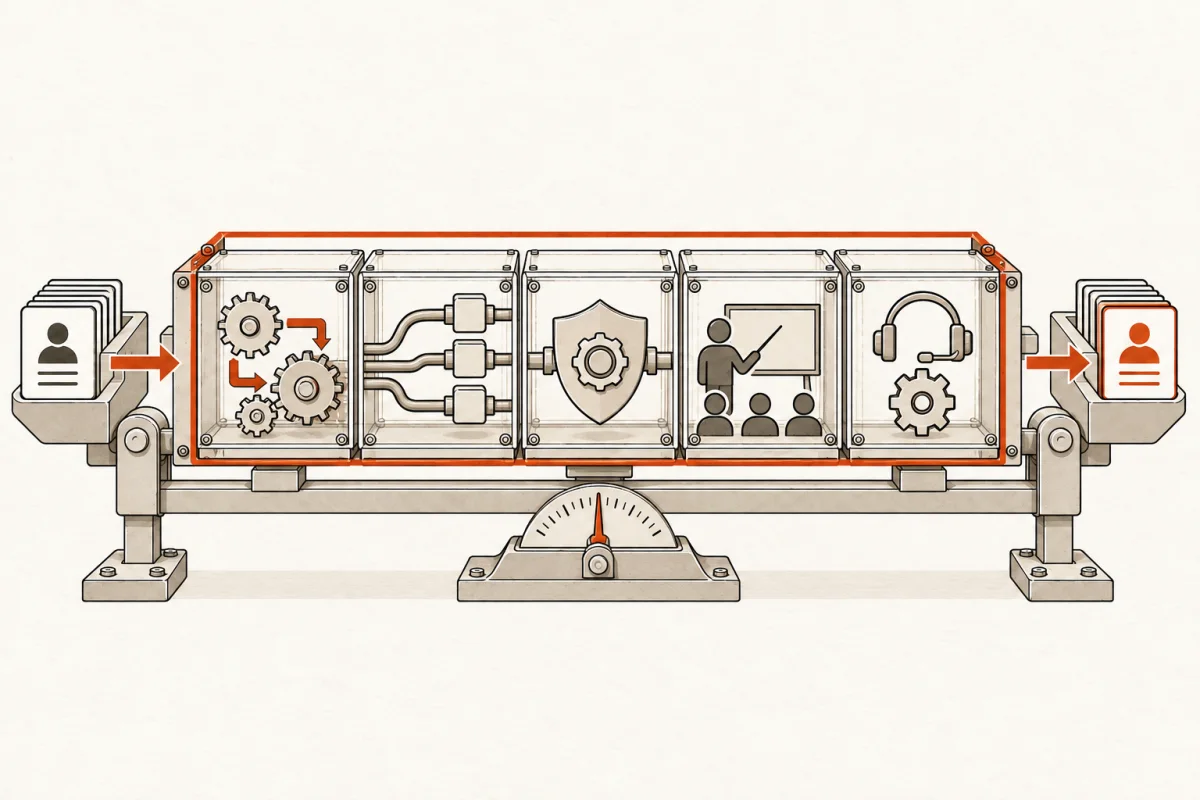
A working system needs someone to map the current process, identify decision points, define exceptions, connect the relevant software, structure the data, build controls, test real cases, train staff, and monitor the result after launch. If the system touches customer information, financial records, health data, or confidential legal materials, security and permission design matter just as much as the AI behavior.
That is why a cheap prototype can become an expensive dead end. It may answer a few sample questions or produce polished output, but it does not know where the business data lives, who can approve an action, what to do when information is missing, or how to hand a case back to a person.
For small and mid-size businesses, the right goal is not broad “AI transformation.” It is a controlled system that removes friction from a high-cost workflow while preserving human ownership of final judgment.
Typical AI implementation cost by scope
A readiness audit: $5,000 to $20,000
A serious audit is more than an interview and a slide deck. It should document the workflows consuming the most labor, quantify the cost of delays and rework, identify data sources and software constraints, assess risk, and produce a prioritized build plan.
This work is valuable when leadership agrees that AI could help but cannot yet answer the basic operational questions: Which process should go first? What data is usable? Who owns the decision? What would success look like in 90 days?
Do not pay for an audit that ends with generic recommendations such as “use AI for customer service.” A useful audit names the workflow, the users, the systems involved, the expected labor or revenue impact, the implementation dependencies, and the measurable acceptance criteria.
A targeted workflow build: $15,000 to $50,000
This is the practical entry point for many businesses. The scope may include a single business process with one or two software integrations, such as inbound lead qualification, client intake, proposal preparation, document summarization, follow-up automation, invoice exception handling, or internal knowledge retrieval.
A good targeted build has a clear boundary. It might collect information from a web form, enrich it against approved sources, create the CRM record, prepare a draft response, and route the record to the correct employee. The employee remains responsible for sending the response or approving the next step.
Costs rise when the process is poorly defined, data is spread across old systems, or the workflow has many exceptions. That does not mean the project is a bad idea. It means the scope needs to account for the work required to make the process reliable.
A multi-workflow operating system: $50,000 to $150,000
This range fits organizations with several connected operational problems. For example, a professional-services firm may need intake, case or project setup, document handling, client updates, time-entry prompts, and management reporting to work from the same business data.
At this level, implementation includes more than automations. It may require a unified data layer, role-based access, multiple AI agents, reporting, workflow orchestration, team training, and testing across departments. The return can be meaningful because the system eliminates handoffs and copy-and-paste work that individual tools cannot solve on their own.
The trade-off is that these projects require an accountable internal owner. Your implementation partner can build the machinery, but staff must validate process rules, provide examples, make timely decisions, and adopt the new way of working.
Enterprise-scale back-office systems: $150,000 to $500,000+
Larger implementations serve companies with multiple departments, complex permissions, legacy software, high volumes, or strict security requirements. They may include custom portals, data pipelines, a larger set of specialized agents, formal audit logs, and deeper integrations with ERP, practice-management, or line-of-business systems.
The price is justified only when the operational value is equally substantial. If a system returns thousands of preparation hours, reduces a long decision cycle, or prevents costly errors across a large team, the case can be strong. If the business has not first identified a measurable bottleneck, a large program is premature.
The five costs that often get left out
Implementation quotes should separate build costs from ongoing operating costs. A low first number can conceal a project that becomes difficult to run, improve, or support.
First, there is discovery and process design. If nobody has documented how work really moves through the company, this is not optional overhead. It is the work that prevents an automation from hardening a broken process.
Second, there is integration. Connecting a CRM, accounting platform, scheduling tool, inbox, document repository, or custom database takes time. Some software has clean interfaces. Some requires workarounds, exports, or custom development. The difference is material.
Third, there is data preparation. AI cannot reliably use information that is incomplete, contradictory, or inaccessible. Cleaning fields, defining a source of truth, and setting retention rules are operational work, not decoration.
Fourth, there are security and governance controls. A business handling sensitive information needs clear answers about access, logging, vendor use, and what data leaves its environment. The right design may cost more upfront, but it reduces avoidable exposure later.
Fifth, there is ongoing support. Expect recurring costs for model usage, automation platforms, software licenses, monitoring, revisions, and managed service. For a smaller system, this may be a few hundred to several thousand dollars per month. More complex systems can require a larger support commitment, particularly when workflows, staff, or source systems change frequently.
How to estimate your own AI implementation budget
Start with labor, not excitement. Choose one workflow and calculate how many hours it consumes each month, who performs the work, and the fully loaded cost of that time. Then add the cost of delays, missed follow-up, errors, abandoned leads, or poor client experience where those costs can be measured.
For example, a five-person operations team may spend 160 hours a month preparing updates, moving information between systems, and chasing missing details. At a conservative loaded cost of $45 per hour, that is $7,200 per month, or $86,400 per year. If an implementation removes or repurposes half of that work, the annual capacity value is about $43,200 before considering better speed or fewer errors.
That does not automatically support a $100,000 project. The savings must be realistic, staff must actually use the system, and the business must have productive work for the recovered time. But it gives leadership a starting point based on operations rather than vendor claims.
A useful budget model includes three cases: conservative, expected, and upside. The conservative case should assume slower adoption and only partial time savings. If the project fails even that case, narrow the scope or choose a different workflow.
What a credible proposal should state in writing
A credible implementation proposal should state the fixed project price or a clear not-to-exceed range, the workflows included, integrations included, exclusions, delivery timeline, acceptance criteria, security responsibilities, training plan, and recurring costs after launch.
It should also state what the AI will not do. Will it draft, recommend, route, or act automatically? Which actions require human approval? What happens when confidence is low or source data conflicts? Those answers are part of the product, not legal fine print.
Be cautious when a provider promises broad transformation before looking at your systems, data, and workflow volumes. Also be cautious when the sales process avoids written pricing, cannot explain ongoing expenses, or treats a proof of concept as proof that production deployment will work.
Main & Machine approaches this as operational infrastructure: identify the highest-cost workflows, build the systems around real tools and data, and keep decisions explainable and overridable by the people responsible for the outcome.
Spend less by narrowing the first deployment
The cheapest useful implementation is not necessarily the smallest one. It is the one with a clear operating boundary, a measurable cost problem, available data, and a team ready to use it.
Start where work is repetitive but judgment still matters. Let AI prepare, organize, flag, and route. Let experienced people approve exceptions, make commitments, and remain accountable. That approach reduces risk while proving whether the business can turn recovered time into better service, faster revenue, or stronger margins.
Before approving a budget, ask one final question: if this system is live in 90 days, what specific work will no longer need to be done manually? If nobody can answer that in plain language, you do not have an implementation scope yet. You have an idea that still needs operational definition.
Where this shows upWhat we actually build →